

I like it when an English lesson becomes a real discussion. Students stop looking to the teacher for the right answer and start responding to one another.
Picture a discussion that is beginning to take off. Then someone says, “English only.” A student starts a sentence, searches for a word, and gives up. Another settles for “I agree,” although she seemed ready to say more. Perhaps they needed to work harder to find the English. Perhaps the rule cut short a discussion that was just getting interesting. I cannot tell from those few sentences alone.
Here, English-only means a rule that prohibits other languages altogether. That is different from expecting English to be the main language of an English lesson. Students need substantial time listening, reading, speaking, making mistakes, and trying again. The difficult part is deciding when the struggle to find English is helping students learn and when it is preventing them from taking part. I do not think every brief use of another language necessarily takes something away from that learning.
A word they know, in a language they don’t
Take evaporation. One student knows exactly what happens to a puddle after the sun comes out but doesn’t know the English word. Another knows that puddles disappear but has never thought much about what happens to the water. The students may give the same uncertain English answer, yet they need different teaching.
For the first student, a quick connection to a familiar term may establish the English label. For the second, translation alone achieves very little. The concept needs teaching too.
Jim Cummins challenged the idea that languages must be kept separate at school. Students bring knowledge from other languages, but that knowledge does not transfer automatically. Knowing that a puddle dries is not the same as understanding evaporation.
A demonstration may be enough. At other times, ten seconds of translation can clear up confusion. The point is to identify what the student needs.
The word they remember next Thursday
Suppose I teach reluctant. I can give a straightforward English explanation, put it in a sentence, and ask students to make their own. I might also give a short equivalent in a language they know. If that clears up confusion, good. But I haven’t finished teaching the word.
Recognizing reluctant in today’s reading is not the same as retrieving and using it naturally next week.
Laufer and Shmueli (1997) found advantages for first-language glosses in the vocabulary tasks they tested. That supports a limited point: translation can help establish meaning, but it does not by itself develop fluent use.
What interests me is whether students can retrieve the word later, in a different context, without a prompt.
Kim and Webb (2022) analyzed 48 experiments involving 3,411 participants and found an advantage for spaced practice in second-language learning. Their study is about practice schedules, not translation. It does remind us why checking a word once is not enough.
I might translate reluctant once, then revisit it in English over the following days until students can choose it independently.
What happens to the thinking?
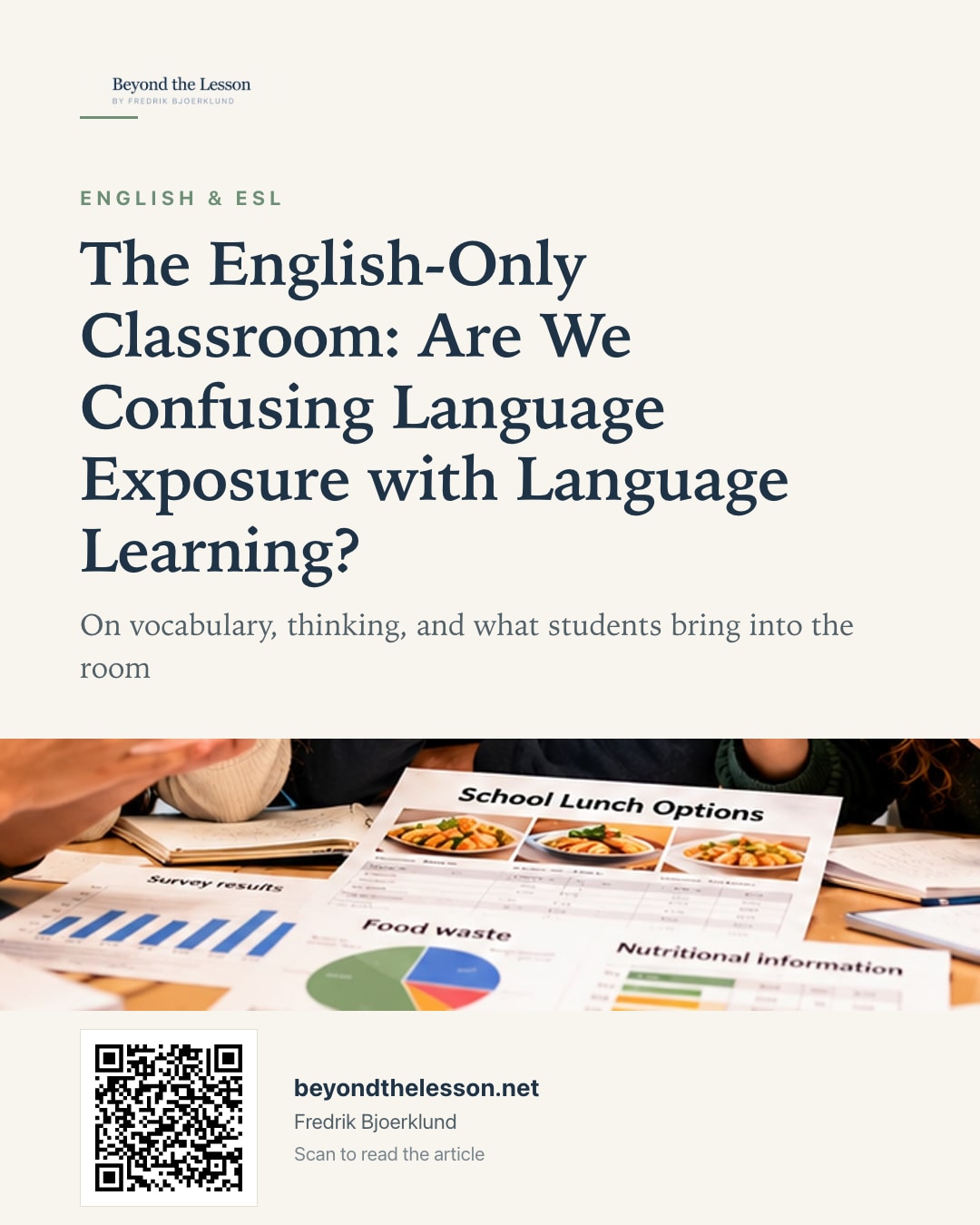
Imagine a group of students investigating whether their school should introduce a healthier lunch menu. They have survey results, food-waste figures, nutritional information, and a proposed budget. Their task is to recommend changes and defend their decisions.
One group recommends replacing a popular fried dish with a healthier alternative. Another points out that students might leave the new meal uneaten, increasing food waste. Suddenly, the question is not simply which meal is healthiest, but which change the school can realistically make. They need to weigh competing priorities, question assumptions, and decide which evidence matters most.
One student can explain a complicated argument in English. Another understands the evidence but can barely express more than a preference. If every contribution must be made in English from the start, that second student’s reasoning may never enter the discussion.
For a task like this, I might allow a few minutes of discussion in a shared first language, where practical. Students could challenge one another’s ideas and compare alternatives before returning to English. But I would not ask them simply to translate a finished conclusion. They would have to explain the evidence, justify their choices, and respond to questions they had not rehearsed. Why reject the cheaper menu? What if the survey is unrepresentative? That is still demanding English work, and it requires fresh thinking.
There is evidence worth considering. In a small study of four undergraduate EFL groups in China, Li and Qu (2024) found that groups encouraged to use multilingual resources engaged in more exploratory talk and showed stronger performance on the study’s measures of higher-order thinking. They also produced more English words in total during the recorded activities, although a smaller share of their talk was in English. Even the groups instructed to use English only sometimes used Chinese. These findings concern the observed discussions, not lasting gains in English proficiency.
Earlier, Swain and Lapkin (2000) examined 22 pairs of Grade 8 French-immersion students completing collaborative writing tasks. Their work documents ways students used their first language while tackling tasks in a second language. It does not establish that discussing first in L1 and reporting afterward in L2 is always the best sequence. That sequence is a teaching choice informed by the research, not a tested formula.
There are limits. In a multilingual group, students may not share a first language, and allowing one language to dominate can exclude others. Private notes, diagrams, carefully chosen pairings, and supported English discussion may be fairer options. Nor would I use L1 as the default when the objective is to negotiate meaning spontaneously in English. That struggle can be part of the learning.
What I would want to see afterward is whether students can explain and defend their reasoning in English, including when the questions change. I would also want every student, not just the group’s strongest English speaker, to explain at least part of the reasoning independently. A brief use of L1 should help students reach more demanding ideas while giving them a reason to develop the English needed to express those ideas.
The language problem may not be the only problem
Two students with similar English may participate very differently. One risks an imperfect answer; another stays silent after being laughed at, or because public disagreement feels uncomfortable. Neither response tells us enough about proficiency.
Culture and previous schooling influence expectations about authority, mistakes, and disagreement. But nationality is not a personality test. I would look at how a particular student responds to a particular task.
MacIntyre and colleagues distinguish language ability from willingness to communicate. Norton and Toohey show why identity and opportunities to participate matter. There is another complication: students sometimes work out what they think by trying to explain it. Speaking is not always the final step after thinking.
Proficiency, confidence, prior knowledge, and task demands matter. That is different from assigning students fixed visual, auditory, or kinesthetic learning styles. Research does not support matching teaching to those labels.
The quiet student in the lunch discussion might need vocabulary, better evidence, partner rehearsal, or a nudge to keep trying. Translation addresses only some of these needs.
What exactly are we assessing?
The same problem shows up in science and history lessons taught through English, where the subject itself is being assessed.
If I am assessing English speaking, the student’s ability to speak English is part of the result. If I am assessing an explanation of a scientific process, the picture is less straightforward. A hesitant English answer may reflect a shaky concept, a shortage of English vocabulary, or both.
Afitska and Heaton (2019) examined science-assessment responses from 485 children aged 7 to 11 across five UK schools. In the standardized assessments they studied, learners with lower English proficiency faced particular difficulties with questions requiring written answers or specific scientific vocabulary. Visual prompts did not eliminate those difficulties. This does not mean every incorrect English answer conceals correct scientific understanding. An answer in another language is not a perfect measure either. Vocabulary, translation, marking consistency, and fairness still matter. I would use different response formats as complementary evidence, not interchangeable scores.
For instance, if a student can draw the water cycle accurately but cannot explain condensation in English, I have learned something more useful than a single mark of wrong. I can now test whether the missing piece is the science, the English term, or the ability to connect them. A drawing, a demonstration, a short explanation in a familiar language where it can be reliably interpreted, and an English response may each provide different evidence. None should automatically replace the assessment required by the curriculum.
Students can learn demanding subjects through English, and that work can develop their language too. But when we assess subject understanding, we need to consider how much English the question requires, not just whether the final answer is grammatically correct.
What a bilingual teacher may notice
I have never been convinced that knowing a learner’s other language should count against an English teacher. The ability to translate is not the same as the habit of translating everything.
A teacher who knows Swedish may recognize a possible reason why a student says “I don’t have an own computer.” In Swedish, Jag har ingen egen dator is a natural way to express the idea. The student may be carrying a familiar structure into English, where “I don’t have my own computer” would sound more natural. That is a possibility to investigate, not proof of what caused the error. Knowing the other language can help the teacher decide what to check next.
A bilingual teacher may notice false friends, understand a student’s explanation of a difficult idea, or remember from personal experience what it took to learn an additional language. Those can be real assets. They do not come automatically with bilingualism, and they are not restricted to teachers who share a student’s home language.
The old native speaker versus non-native speaker debate often seems less useful to me than asking what a teacher actually knows how to do. Can the teacher make English understandable without making it trivial? Can they recognize a language problem without assuming the student lacks ideas? Can they use a quick comparison and then create a reason for students to speak English themselves?
Medgyes questioned simplistic native-speaker hierarchies decades ago. More recently, Scherzinger and Brahm reviewed 79 reports on competencies for bilingual education teachers and identified 16 recurring areas of expertise, many involving language knowledge and pedagogy. That is a framework for thinking about professional competence, not evidence that bilingual teachers automatically get better results. A teacher who does not share students’ home languages can be excellent at this work. A bilingual teacher can overtranslate and leave students with too little English practice.
When staying in English is the point
Much of the time, I would keep students in English.
If students can work out a word from a carefully chosen example, I want them to try. If they can negotiate a misunderstanding, test a hypothesis, or disagree constructively with a classmate in English, that conversation is itself part of the thinking, not merely a report of ideas formed earlier. If they are capable of defending an idea in English but keep returning to a familiar language out of habit, I may insist they stay with the challenge.
There is a real opportunity cost when we switch languages: minutes spent explaining in a familiar language are minutes not spent negotiating meaning in English. The benefit has to justify that cost. Students need more than correct answers. They need practice listening when they don’t understand every word, finding alternative ways to explain something, noticing gaps in their English, and repairing what they say. A classroom that immediately translates everything can deprive them of those opportunities.
The research gives us reasons to be cautious. Huang and Chalmers’ 2023 systematic review found ten eligible EFL intervention studies. Five favored pedagogical translanguaging, but four of those five had a high risk of bias. The review did not justify confident claims that one approach generally outperforms the other. It also examined a particular set of translanguaging interventions, rather than every instance of a teacher briefly explaining a word in L1.
These choices have different purposes. A quick word gloss, a short period of multilingual planning, and an extended L1 discussion each involve different trade-offs. I would judge them against the lesson objective and the opportunities students still have to think and communicate in English.
A decision in the middle of a lesson
Before switching languages, I would want to know what problem the switch is meant to solve. In a busy classroom, that often means a quick check rather than a formal diagnosis: ask for an example, invite a sketch, give thirty seconds of partner rehearsal, or ask for the idea in simpler English. If the student can continue, I may not need to translate at all.
Is the student missing a concept or an English word? Could a picture, demonstration, or simpler English explanation work? If L1 would help, how much is enough? What English will students need to use afterward? And what will they be able to do without help later?
These are practical checks I can make while a lesson is moving. They help me decide whether students need more language support, more conceptual explanation, or simply more time to think. A smoother discussion tells me something about participation today; a later task with less support tells me more about what students retained and can do independently.
What matters to me is what happens when the help is gone. A student who can explain the claim in English on Friday, without the original prompt or translation, gives me stronger evidence of learning than a polished answer produced with extensive help on Monday. That later check is not a perfect measure, but it makes the purpose of the support clearer.
When AI hides the evidence
AI makes this problem harder to spot. A student can now turn a rough idea into polished English in seconds. The result may sound impressive, but I still need to know whose English I am reading.
AI can help a teacher prepare a short explanation in an unfamiliar language or create extra vocabulary retrieval questions. That may save preparation time, but it does not establish learning. Translations need checking where possible, particularly for less-resourced languages, and identifiable student information should not be entered into tools without appropriate safeguards.
Students can also ask AI to do almost everything: translate the reading, write the argument, improve the answer, and supply the vocabulary. The finished work may look better while revealing less about what the student can actually do.
If students use AI, I want them to attempt the task first, seek specific help, and try again. Later, I want to see what they can do without it. That is how I would use the tool in my classroom, not a claim that this particular routine has been experimentally proven.
The question I would rather ask
It is easy to check whether a class is following an English-only rule. Walk past the room and listen. It is much harder to know what students have learned. Schools should expect ambitious English use, but I would rather ask teachers what students were learning and how they knew their approach was working than judge a lesson by whether another language was heard.
So after a lesson, I would rather ask: What can students understand, remember, question, and say in English now that they couldn’t before?
If a brief explanation in another language helped, I want to know what it made possible and whether students can now manage without it. If we kept everything in English, I want to know whether students learned from the struggle or simply stopped contributing. We cannot judge either lesson by counting the languages we heard.
Research informing this article
The studies below inform the discussion; the classroom examples and proposed routines are professional interpretations, not interventions validated as a package.
Afitska, O., & Heaton, T. J. (2019). Mitigating the effect of language in the assessment of science: A study of English-language learners in primary classrooms in the United Kingdom. Science Education, 103(6), 1396–1422. https://doi.org/10.1002/sce.21545
Cummins, J. (2007). Rethinking monolingual instructional strategies in multilingual classrooms. Canadian Journal of Applied Linguistics, 10(2), 221–240. https://journals.hil.unb.ca/index.php/CJAL/article/view/19743
Huang, X., & Chalmers, H. (2023). Implementation and effects of pedagogical translanguaging in EFL classrooms: A systematic review. Languages, 8(3), 194. https://doi.org/10.3390/languages8030194
Kim, S. K., & Webb, S. (2022). The effects of spaced practice on second language learning: A meta-analysis. Language Learning, 72(1), 269–319. https://doi.org/10.1111/lang.12479
Laufer, B., & Shmueli, K. (1997). Memorizing new words: Does teaching have anything to do with it? RELC Journal, 28(1), 89–108. https://doi.org/10.1177/003368829702800106
Li, M., & Qu, Z. (2024). Encouraging translanguaging in collaborative talk in EFL classrooms: An epistemic network comparative study. Linguistics and Education, 84, 101360. https://doi.org/10.1016/j.linged.2024.101360
MacIntyre, P. D., Clément, R., Dörnyei, Z., & Noels, K. A. (1998). Conceptualizing willingness to communicate in a L2: A situational model of L2 confidence and affiliation. The Modern Language Journal, 82(4), 545–562. https://doi.org/10.1111/j.1540-4781.1998.tb05543.x
Medgyes, P. (1992). Native or non-native: Who’s worth more? ELT Journal, 46(4), 340–349. https://doi.org/10.1093/elt/46.4.340
Norton, B., & Toohey, K. (2011). Identity, language learning, and social change. Language Teaching, 44(4), 412–446. https://doi.org/10.1017/S0261444811000309
Pashler, H., McDaniel, M., Rohrer, D., & Bjork, R. (2008). Learning styles: Concepts and evidence. Psychological Science in the Public Interest, 9(3), 105–119. https://doi.org/10.1111/j.1539-6053.2009.01038.x
Scherzinger, L., & Brahm, T. (2023). A systematic review of bilingual education teachers’ competences. Educational Research Review, 39, 100531. https://doi.org/10.1016/j.edurev.2023.100531
Swain, M., & Lapkin, S. (2000). Task-based second language learning: The uses of the first language. Language Teaching Research, 4(3), 251–274. https://doi.org/10.1177/136216880000400304